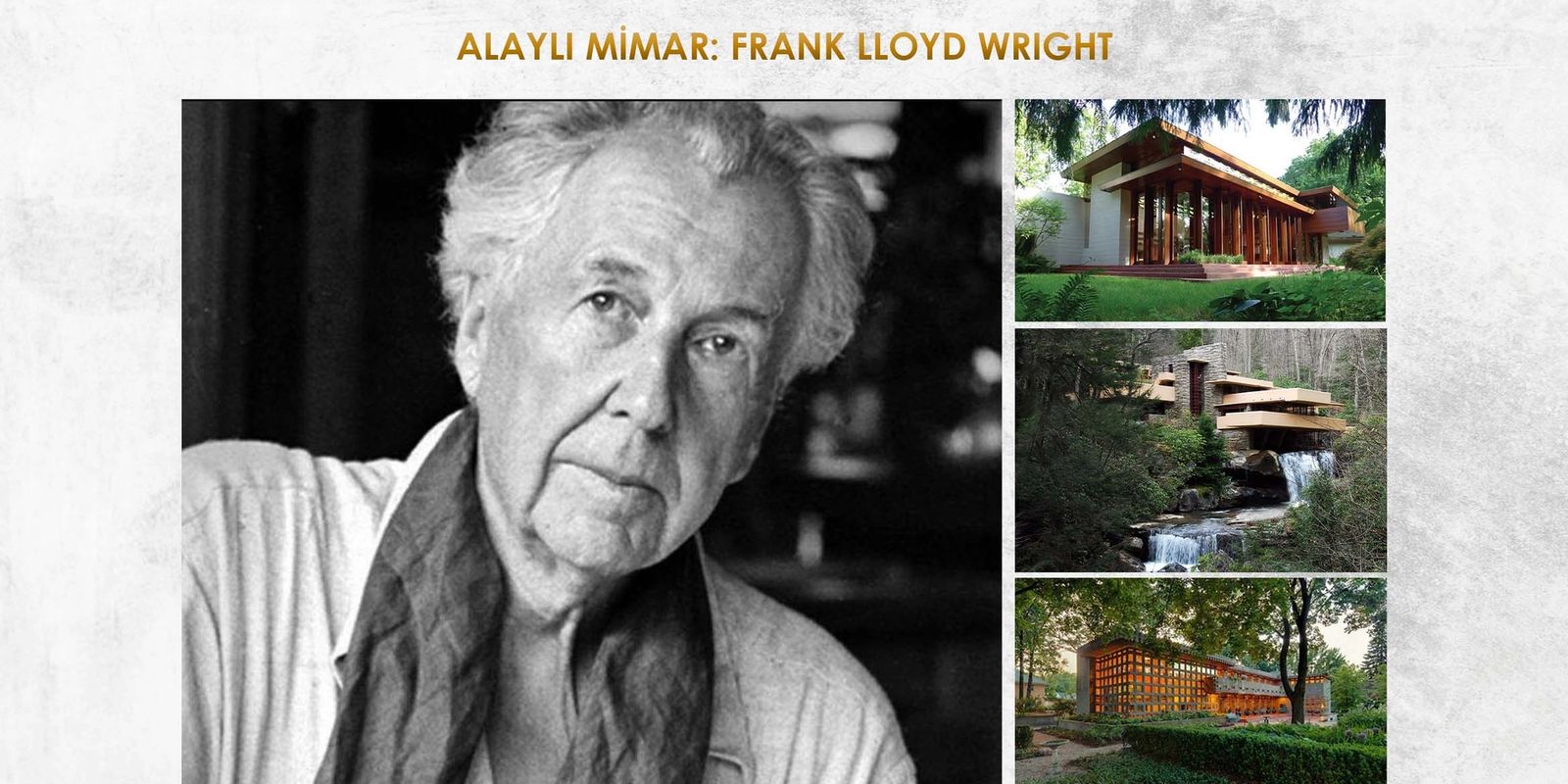
THE SADLY ARCHITECT: FRANK LLOYD WRIGHT
Updated:
THE SELF-TAUGHT ARCHITECT: FRANK LLOYD WRIGHT
This week, T-COD Architecture wants to talk to you about the architectural philosophy and works of Frank Lloyd Wright, an architect who preferred using materials in a way that suited their forms rather than shaping them, showcasing nature and architecture in harmony.
WHO WAS FRANK LLOYD WRIGHT?
Born in Wisconsin in 1867, the American architect was the eldest of three children of William Russell Cary Wright, a clergyman and music teacher, and Anna Lloyd Wright, a teacher. Due to his family's financial difficulties, Wright dropped out of high school and began working part-time for Allon Conover, the Dean of the Engineering Faculty at the University of Wisconsin. He also took technical drawing and mathematics courses as a private student at the same faculty. One of Frank Lloyd Wright's striking characteristics is that he was a "self-taught" architect, meaning he did not receive a formal university education in architecture. In 1887, the architect left home and went to Chicago to work as a draftsman, spending a few months with the famous architect Joseph Lyman Silsbee. During this time, he learned about residential architecture. Wright then joined the Adler-Sullivan office as an assistant architect, working under Louis Sullivan, the most famous architect of the Chicago School. He worked at the Adler-Sullivan office until 1893, serving as the head of the Planning and Design department. Adler and Sullivan, not wanting to build detached houses themselves, asked Wright to handle these designs. Wright distinguished himself with his successful house designs, and upon realizing the need for outsourcing, he left Adler-Sullivan in 1893 and established his own office in Oak Park.
FRANK LLOYD WRIGHT'S ARCHITECTURAL PHILOSOPHY
Frank Lloyd Wright, whose architectural philosophy was based on simplicity and flexibility, challenged the ornate, elaborate, and detailed architectural style. Utilizing the grandeur of simplicity, Wright integrated geometric facades into his buildings, making them an integral part of nature. He opposed the complete arrangement of the site where a building would be located, advocating for respect for and harmony with nature. According to Wright, a building should become an integral part of its location. Fallingwater, one of Wright's works that laid out the principles of organic architecture, is a landmark of organic architecture. Built for the Kaufmann family, this house was constructed in perfect harmony with nature, using materials sourced from the land.
FRANK LLOYD WRIGHT'S WORKS
Among Frank Lloyd Wright's most important projects are: • Fallingwater House (Kaufmann House) • Usonia Houses • Solomon R. Guggenheim Museum • Prairie Houses • Larkin Administration Building • Taliesin School and numerous other houses. The common feature of all these structures is that they are designed to be in harmony with nature.