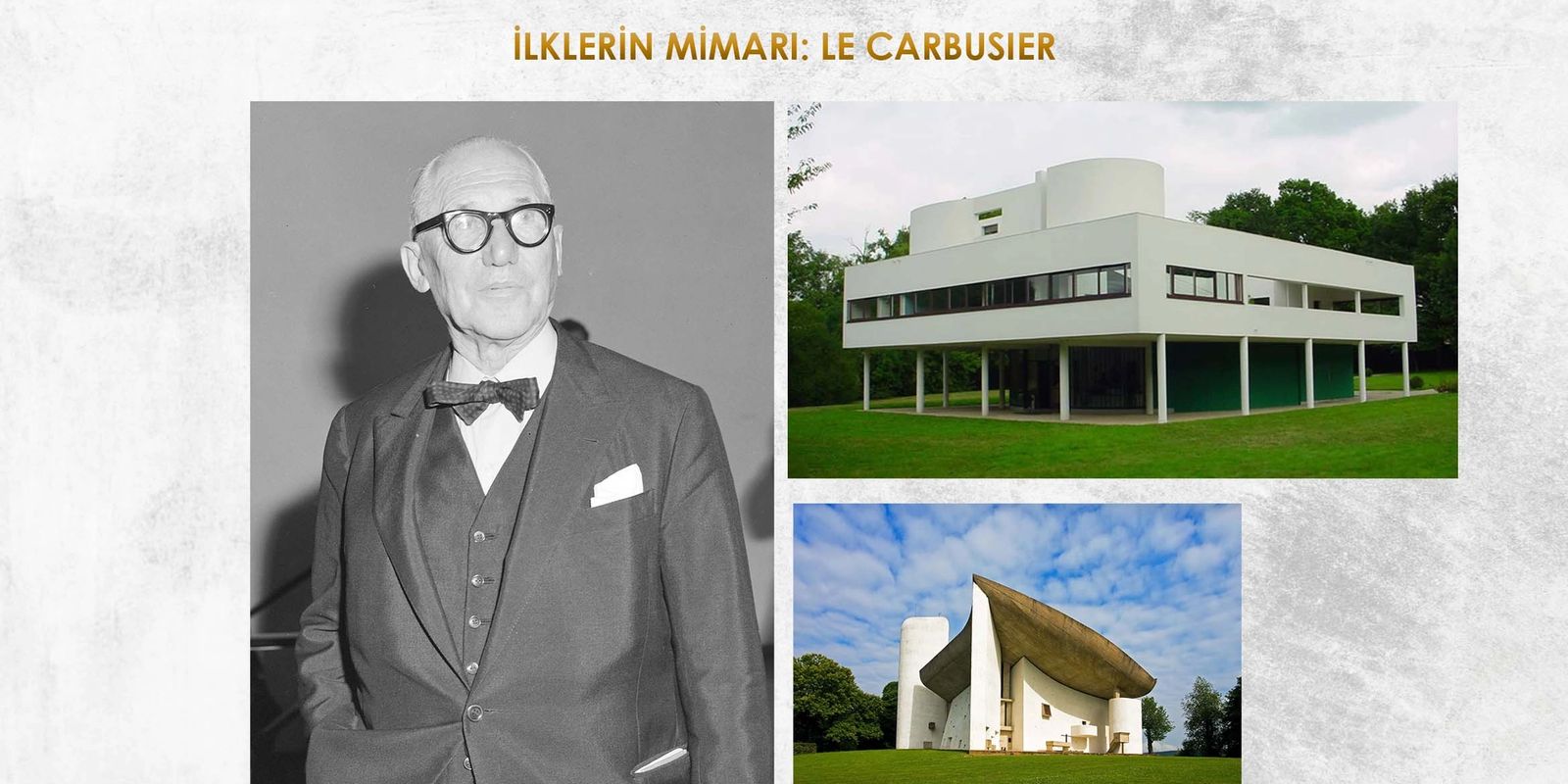
THE ARCHITECT OF FIRSTS: LE CARBUSIER
Updated:
THE ARCHITECT OF FIRSTS: LE CARBUSIER
This week, T-COD Architecture wants to talk to you about Le Carbusier, considered a groundbreaking architect of his time. Let's take a look at Le Carbusier's architectural philosophy and professional career. Born in La Chaux-de-Fands, Switzerland, Le Carbusier was a Swiss-born French architect. At the age of 13, he left school to work alongside his father, a clockmaker. Between 1907 and 1911, Le Carbusier traveled through Central Europe and the Mediterranean countries, apprenticing with various architects. Some of these included the Parisian architect Auguste Perret, who used reinforced concrete in his buildings, and Peter Behrens, one of the first industrial designers. These travels marked the beginning of his architectural journey and professional career, and he became closely interested in Mediterranean and Central European architecture. He dedicated himself to creating better living conditions for mass housing and crowded cities. Because of this approach, his architectural style has been described by critics as soulless monoliths (single-piece struts). Carbusier, who was also a city planner, painter, sculptor, writer, and modern furniture designer, is known for his contributions to modernism and the international style.
LE CARBUSIER: “SOMETHING IS BEAUTIFUL IF IT MEETS A NEED.”
Le Carbusier, one of the leading figures of the 20th century, was criticized during his lifetime, but he has profoundly influenced architectural and urban planning today. He was the first to consciously use exposed concrete and the first to use columns in buildings, changing the entire understanding of architecture. By relieving the load-bearing walls, he freed the design and increased functionality.
LE CARBUSIER'S FIVE BASIC DESIGN PRINCIPLES
• Columns taking on all the load by relieving the walls from being load-bearing, • The load-bearing elements and walls of the structure are functionally independent of each other,
• The reinforced concrete structure is used as an aesthetic element in addition to its technical function,
• Horizontal band windows, extending as part of the free facade, illuminate the interior,
• The roofs on the top floor are transformed into terrace gardens to ensure the building's harmony with the natural environment.
He applied all these principles in his well-known works, including Villa Sovaye, which was added to the UNESCO World Heritage List.
VILLA SOVAYE
Considered one of the most important buildings in the world, Villa Sovaye was designed in accordance with the characteristics of the modernist movement and Carbusier's architectural principles. The building, which embodies Le Carbusier's five fundamental design principles, is elevated above the ground and separated from the earth. The terrace is used as a rooftop and designed as a garden. Horizontal windows are used. The open-plan system eliminates boundaries in the plan, and the building's facade is separated from the load-bearing elements, providing freedom in facade design. Le Carbusier, considered a groundbreaking architect of his time, continues to influence with his architecture even today.