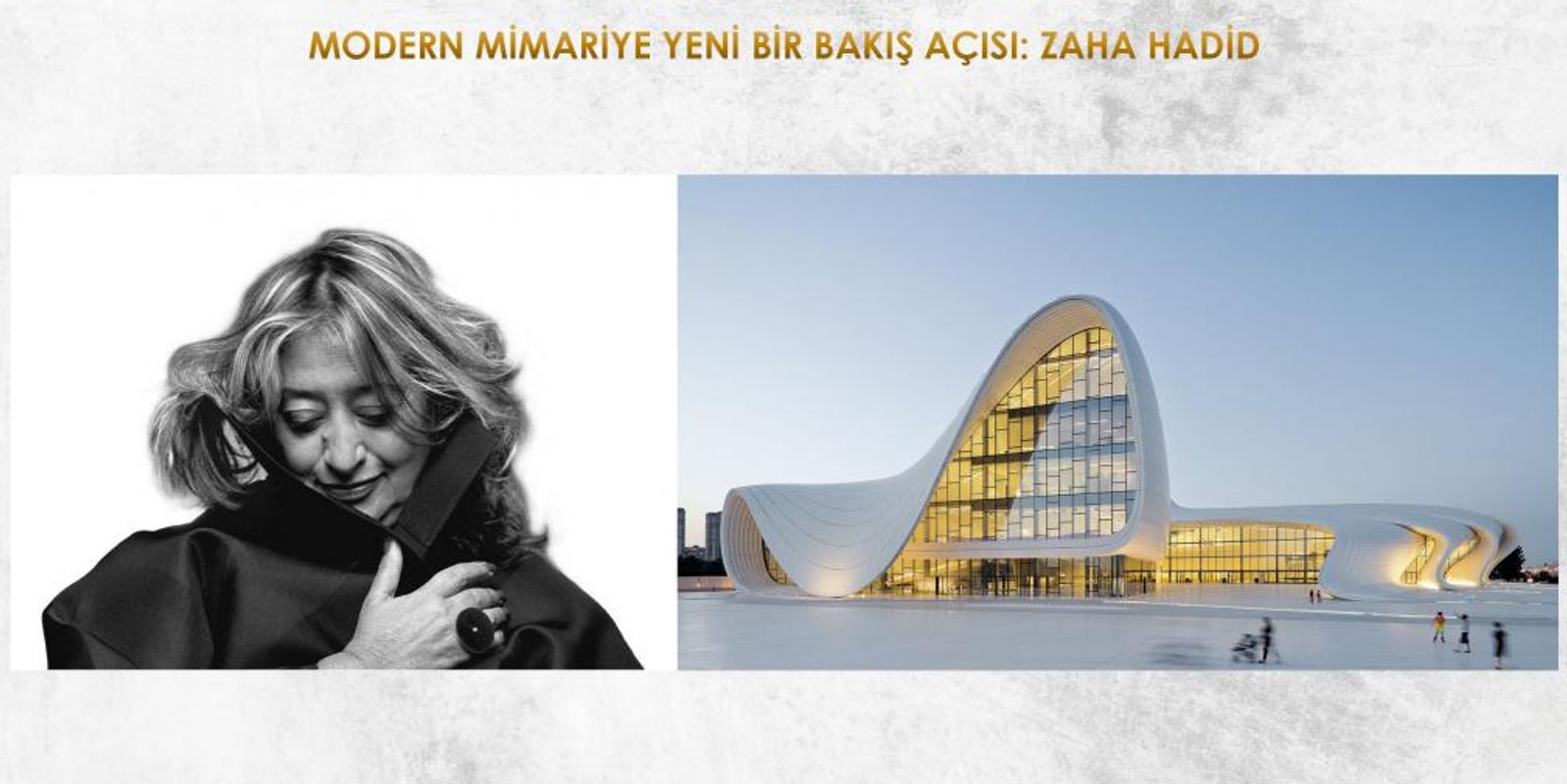
A NEW PERSPECTIVE ON MODERN ARCHITECTURE: ZAHA HADID
Updated:
A NEW PERSPECTIVE ON MODERN ARCHITECTURE: ZAHA HADID
This week, T-COD Architecture wants to talk to you about Zaha Hadid, one of the icons of the architectural world. Let's take a look at the life of Zaha Hadid, who brought a new perspective to the concept of modern design with her curvilinear designs.
WHO IS ZAHA HADID?
Zaha Hadid is an Iraqi-born British architect who gave architecture a completely new expression with her deconstructivist architectural approach and buildings with surprising forms. Born on October 31, 1950, in Baghdad, Iraq, Zaha Hadid is the daughter of Mohammad Hadid, who also served as the finance minister of Iraq, and Wajiha al-Sabunji, an artist from Mosul. She was born into an upper-class family. Her father, a politician who advocated for secularism and democracy, sent Zaha Hadid to a British boarding school despite being Muslim. After graduating from boarding school, she received a degree in mathematics from the American University of Beirut, followed by architectural training at the Architectural Association in London. Hadid, who worked for a time at the Office For Metropolitan Architecture, a firm co-founded by her professors Rem Koolhaas and Elia Zenghelis—who described her as "an inimitable planet in its own orbit"—established her own architectural firm, Zaha Hadid Architects, in London in 1980 as soon as she became a British citizen.
ZAHA HADID: ARCHITECTURAL STRUCTURES AND AWARDS
Zaha Hadid, who liberated architectural geometry, wasn't yet building anything in the 1980s, a period marked by the rise of postmodernism. However, she was creating snapshots of a world that didn't yet exist, with strange forms that couldn't be defined as buildings in the traditional sense, giving an artistic dimension to the sense of uncertainty.
THE PEAK
Zaha Hadid created one of her first designs in 1983 for a competition in Hong Kong for the design of a resort complex known as The Peak. The project consisted of three horizontal buildings and spatial voids between them. Notable for its reinterpretation of the relationship between structure and land, the project, although entirely feasible from an engineering perspective, was never realized. However, in 1988, she took a significant step in her career by participating in the Deconstructivist Architecture Exhibition at the Museum of Modern Art in New York with The Peak Project, becoming one of seven architects featured in the exhibition.
FIRST PRACTICAL PROJECT: VITRA FIRE STATION
Zaha Hadid, who has constructed many extraordinary buildings throughout her career, had her first practical project in 1993 with the Vitra Fire Station. Rolf Fehlbaum, the owner of the Vitra furniture company, was the one who gave Hadid her first opportunity to work as an architect. The Vitra Fire Station, Hadid's first structure, was built in Weil am Rhein on the Swiss-German border for the company's volunteer fire department.
CARDIF BAY OPERA HOUSE
Her groundbreaking project in England was the Cardiff Bay Opera House. Selected from 400 participants in an international competition in 1994, the project masterfully achieved monumentality befitting a national institution. It also infused a sense of urbanity into a vast expanse of empty land.
A KEY PART OF THE CULTURAL REVOLUTION: THE GUANGZHOU OPERA HOUSE
The Guangzhou Opera House, completed in 2002, was Zaha Hadid's first project in China and has made a significant contribution to the city's cultural development. Zaha Hadid drew inspiration from river valleys when designing the structure, which resembles two large rocks shaped against the current and overlooks the Peart River. Considered one of the most important parts of the cultural revolution, the building has created a bridge between the city's financial center and its cultural structures.
THE FIRST FEMALE ARCHITECT TO WIN THE PRITZKER PRIZE: ZAHA HADID
Zaha Hadid became the first woman architect to win the Pritzker Prize in 2004. Throughout her career, she has constructed many extraordinary buildings, but the Maxxi Art Museum in Rome, completed in 2010, earned her the RIBA Stirlin Prize. In 2012, he designed the Olympic Aquatics Centre for the Summer Olympics in London, a structure whose form is inspired by the geometry of moving water.
In striking structures such as the BMW car factory she designed in Leipzig, Germany, the skyscraper complex built in Beijing, and the Heydar Aliyev Cultural Center in Baku, Azerbaijan, Zaha Hadid had the opportunity to realize ideas where walls and roofs seamlessly merge, both inside and out, in ground plan and cross-section. Wanting to be known simply as an architect, not as a female architect or an Arab architect, Zaha Hadid had the chance to realize many significant projects for cities and architecture, like the structures mentioned above. Zaha Hadid, who etched her name in gold in her architectural career, passed away in Miami on March 31, 2016, due to a heart attack.
At T-COD Architecture, we are inspired by Zaha Hadid's unconventional architectural design potential, her buildings, and her highly developed three-dimensional vision. With utmost respect for her architectural perspective, we bring to life corporate buildings, youth centers, and hall architecture within the scope of our projects.