ARCHITECTURE AND TECHNOLOGY INTEGRATION IN NEV201 OFFICE PROJECT: NEW GENERATION OFFICE DESIGN WITH SMART SCREEN
Updated:
ARCHITECTURE AND TECHNOLOGY INTEGRATION IN NEV201 OFFICE PROJECT: NEW GENERATION OFFICE DESIGN WITH SMART SCREEN
This week, as T-COD Architecture, we would like to tell you about how we handle architectural design and technology together. Today, office projects not only meet aesthetic expectations; flexibility, digital infrastructure and user experience are also becoming key components of design. We implemented a strong example of this approach in the office project we realized at Nev201. In the project, we designed technology as a natural part of the space, without separating smart screen applications from architecture.
WHY SHOULD TECHNOLOGY BE CONSIDERED FIRST IN ARCHITECTURAL DESIGN? In many projects, technology is considered as an added element after the architectural design is completed. This often causes spatial integrity to deteriorate and the technology to be perceived as a "foreign piece". However, architecture and technology integration reveals its true value when considered at the very beginning of the design process. In the NEV201 office project, we evaluated technology as a fundamental element affecting design decisions, not as an equipment installed later.
DEFINING SPACE WITHOUT DIVITING THE SPACE WITH SMART SCREEN APPLICATIONS
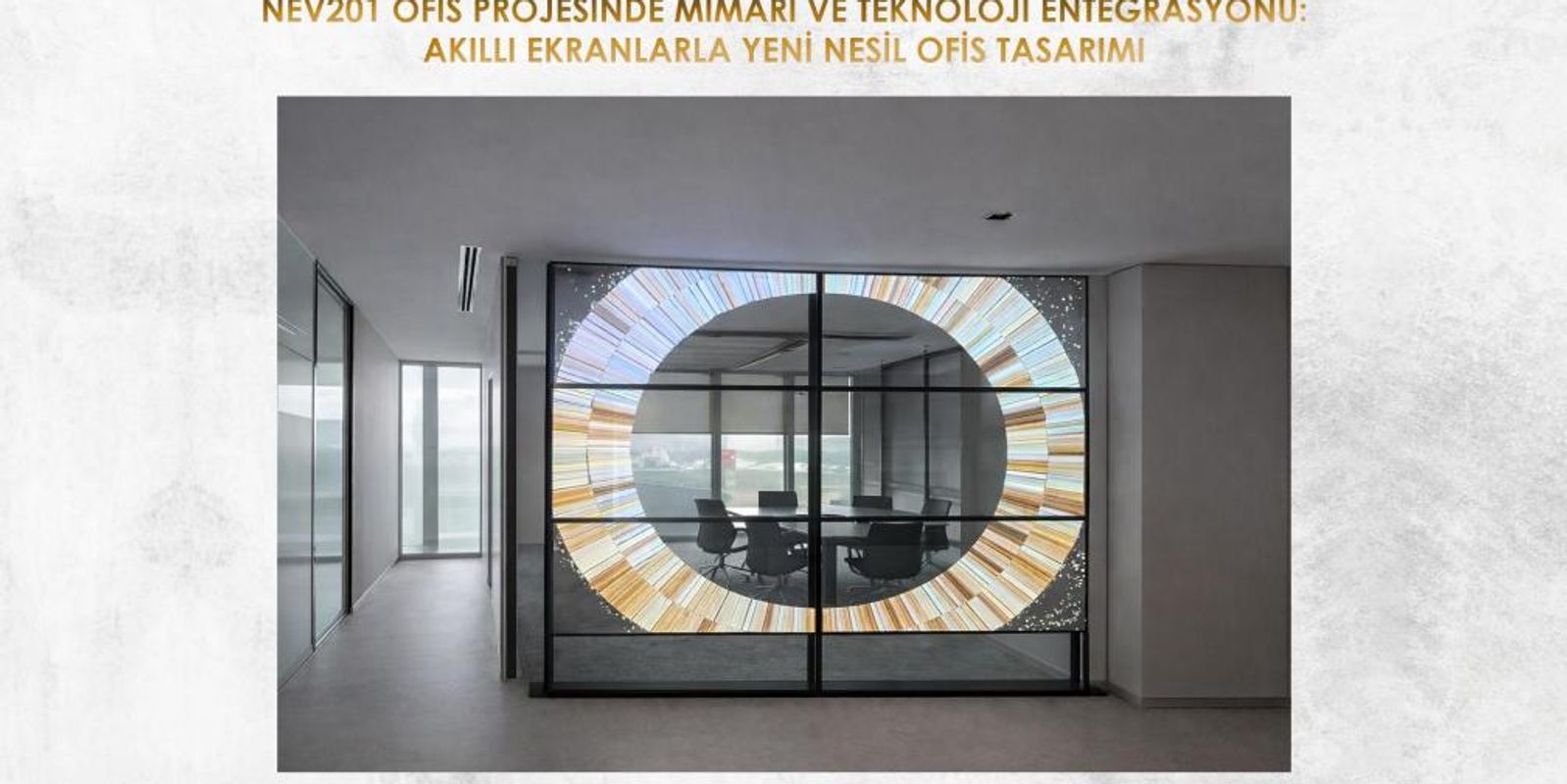
One of the important areas in the project was the meeting room. Classic solutions; While it was based on building walls or separating the space with glass partitions, we adopted a different architectural approach.
THE SPACE WAS NOT DIVIDED, THE EXPERIENCE WAS ENRICHED
Thanks to the way smart screens are designed: The general spaciousness of the office was preserved. Instead of hard borders, permeable areas were created. The meeting space offered both a physical and digital experience. Here, technology has turned into a design tool that multiplies the usage scenarios of the space rather than dividing it.
HOW WAS THE INTEGRATION OF SMART SCREENS WITH ARCHITECTURE ACHIEVED? One of the common problems in smart screen applications is the positioning of the screens without establishing a relationship with the architecture. In the Nev201 office project, the screens are; Compatible with the axes of the space Considering the balance of scale and proportion It was designed to integrate with the architectural language and material character. The aim is not to highlight technology; was to make it a natural extension of architecture.
THE ROLE OF SMART SCREENS IN NEW GENERATION OFFICE DESIGN
Thanks to this approach, in the Nev201 office project: Meeting areas were opened for multi-purpose use. Digital and physical experience were designed together. A more flexible and contemporary working environment was created in the office. Smart displays are not just a presentation tool; It has become an active part of office interior architecture.
ARCHITECTURE AND TECHNOLOGY ARE DESIGNED TOGETHER AT T-COD ARCHITECTURE
As T-COD Architecture, we use technology not as an added layer on top of architecture; We consider it as an integral part of architectural design. Smart screens and digital systems only gain meaning within the correct spatial setup. The Nev201 office project is a concrete example of how architecture and technology, when considered together, can create a powerful spatial experience. Technology finds its true value when it is designed together with architecture, not when it is added to architecture later.